Active LearningArts in EducationBlog - 20 Stories for 20 Years
Young Voices Demand in the Open Land: Poetry in Action’s Alex Wharton on Finding Spatial Belonging through Poetry Writing
Written by Lauren Milne
Journalist and Literary Content Officer (Volunteer) | Poetry in Action
Before English was ever written or spoken in Australia, our First Nations People were using storytelling to communicate the inextricability of belonging, identity and land. Now, Alex Wharton brings rap battle competitions to Year 9s in Gunnedah. The prize for First Place? The feeling of home, even in a sweltering classroom on a Friday afternoon…
I would like to acknowledge the Traditional Custodians of the diverse lands on which I am writing on. I pay my respects to the First Nations peoples, their cultures, and their Elders past, present and emerging. I acknowledge them as the original and traditional storytellers of this land.
Australian land has and always will belong to our First Nations Australians. We are also a proud multicultural land. For those of us who are settlers, borrowers, of these beautiful, vast plains, we are just beginning to discover the opportunities of storytelling for explaining the complexities of our relationship to physical space. Each and every story told and shared about place is an important stitch in the patchwork quilt of the Australian notion of “belonging” to our physical environment.
Where do we begin?
Belonging, or lack thereof, is one of these “universal human experiences” one that each of us grapples with every day, so much so that the existentialism of finding belonging has spawned numerous platitudes in the English language (think of the very cliche “Just be yourself and you’ll find your place”).
In Year 12 English in NSW, the core module is “Texts and Human Experiences”, and “belonging” was the first (and second and third and fourth) word you wrote on your hand to remind yourself what to write about in the exam. But do many of us really feel a sense of home in our cities, amongst our peers at the pub, our backyards, our workplaces, our farmlands? Maybe, but maybe not.
When we are youngsters, the first test we put our relationship with the physical world through are our first steps. Will the ground hold us, or will we fall straight through it? Once the sensation of walking becomes familiar and we trust that concrete won’t crumble beneath us, we start using our sense of touch to further categorise what is “safe” and “unsafe” in the environment. Our fingers start touching everything, discovering what feels fuzzy, bumpy, smooth, grainy, slimy, what burns our fingertips and turns them red and what is so cold it bites and stings. We assert ourselves into environments in a bid to understand them, creating
experiences that shape whether the world becomes one of two options a) gradually familiar and safe or b) even scarier and more foreign.
Places that we keep being drawn back to become dependable, even desirable, to be within, and eventually start contributing to our early ideas of belonging and identity. Any toddler who goes from crying in their parents’ arms begging not to be left at the doors of preschool to running excitedly to the sandbox without so much as a second look at Mum or Dad is proof of this.
However, when we are adults, our lust for exploration becomes stagnant and our processes of filtering places we belong versus places we don’t feels like a luxury we just can’t afford, our heads too busy and our bodies too heavy. We stop discerning, maybe even start feeling trapped, and environments become places we survive in as opposed to places we can thrive in. Even our great Australian cities, like Sydney and Melbourne, fill our lives with overstimulation and overconsumption, which leads to, unsurprising, overwhelm, and exhaustion. And these are the places we supposedly “belong”…
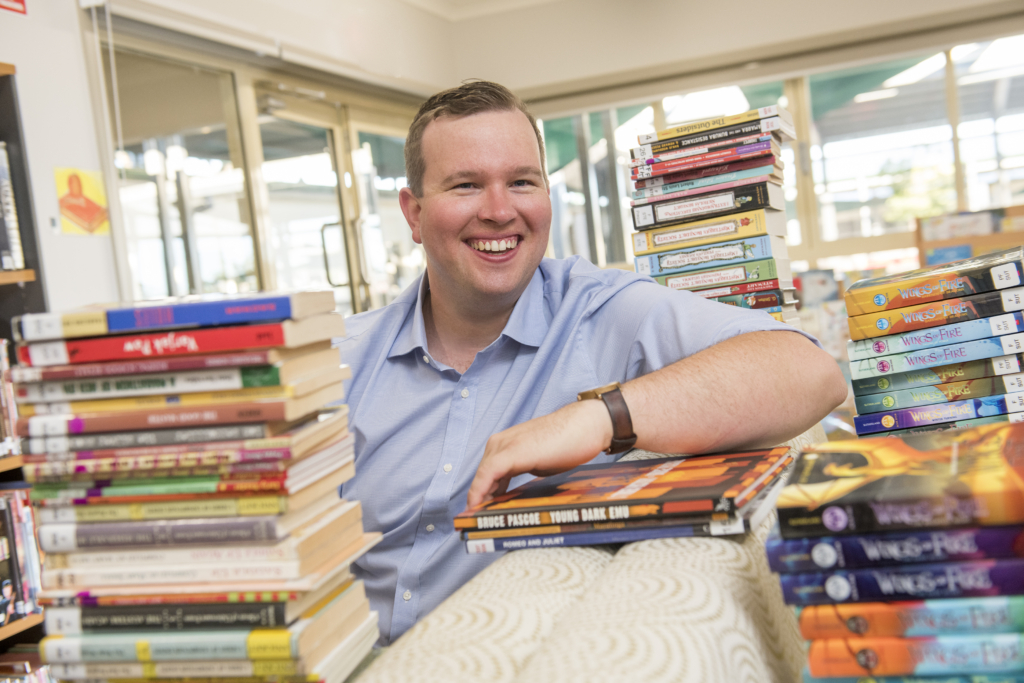
So, what Alex Wharton, proud English teacher and Poetry in Action Ambassador tells me as our interview begins has me rethinking my previous cynicism on adults and disconnection (always a blessing for me).
“I’m from a small town called Gunnedah”, the smiling Alex tells me proudly. “Ever heard of it?”.
The look on my face must have said it all. I’m a little (a lot) embarrassed.
“You must know Dorothea Mackellar’s poem that goes like “I love a sunburnt country…?”
“Yeah, of course!”
“Well, it’s about Gunnedah…”
Dorothea Mackellar wrote ‘My Country’ while enduring debilitating homesickness for the blinding Australian sun from the gloomy clouds of the UK. She uses storytelling in the form of poetry to express her love of the land during an unspeakably dark period of Australia’s colonial history. Famously, the closing lines of Mackellar’s poem are “Wherever I may die,/I know what brown country/My homing thoughts will fly”. Here, the unique affordances of poetry with its proclivities for abstract imagery, allow Mackellar to process her nostalgia for the Australian outback, and she brings the reader along on a journey of expressing great
devotion to her homeland.
The Naturalists view humans as fully integrated with the natural, material world, and that because of this our well-being is invariably tied to the environment. I do agree with this, but it’s an only small fraction of our history in Australia of using storytelling to process complex feelings of home and kinship to land.
Before our interview, I had never heard of Gunnedah, located on traditional Kamilaroi land. With eager ears, I listen as Alex tells me more about it.
“I’m an English teacher. At my school, there’s a 53% Aboriginal and Torres Straight Islander student population. A lot of our students come from farms, or live in the town itself but their parents are working on the farms. It’s quite an agricultural and mining kind of community. There’s amazing opportunities, and great challenges to overcome in terms of rural and remote learning with technology. That’s our context”.
As Australians, we are fortunate enough to share in a history of belonging that pre-dates our colonial history and extends into time immemorial. The beautiful traditional of storytelling on Australian land and connection to physical environments belongs to our First Nations People. To borrow some words from one of my favourite First Nations poets (and one of the greatest political voices of our generation) Evelyn Araluen writes in her poem “Learning Bundjalung on Tharawal” in her collection Dropbear that “We are relearning this place through poetry/I open my book and say, wayan, here is a word which means road, but also root/and in it I am
rooted, earthed, singing between two lands”.
Our young people navigating primary school, high school and even university, sit somewhere in the middle of going about the world with a child-like wonder, and an apathy and passivity that has debilitating consequences for their adult lives. Alex, with his “walking-on-sunshine” glow, his boyish charm and sparkling enthusiasm, is a breath of fresh air guiding our young students to hold onto their childish wonder with iron grips. He’s doing what he can to make sure that the way he teaches English in Gunnedah is not only practical but adaptable so his students have the best chance at seeing the relevance of creative writing.
“I had Poetry in Action come to me as a school student”, Alex tells me when I ask how he got started with not only teaching, but PIA itself. “Now, as an English teacher with the English Teachers Association, part of my work with Poetry in Action is to make sure our students are involved and exposed to the arts in as many different ways as possible and then trying to get Poetry in Action to as many different schools as we can in regional communities”.
He’s a glass-half-full-kind of guy, but we’re also quickly acknowledging important caveats to the context of his work in Gunnedah. “I think that, because we don’t have access to the cities, there’s some major disadvantage and inequality issues with teaching the arts in regional communities. I would love to take my kids to a poetry slam, but it’s not always possible. But I know the healing and transformative power of the spoken word, so I bring poetry to the kids through the internet”.
Alex tells me about the poetry rap battles he finds on YouTube for his Year 9 and 10 students to watch. He’s got them involved in rap competitions where his students are writing and collaborating together. I quickly realise what I admire about Alex: he reminds me of my high school English teachers. He’s innovative. He believes in potential, and nurtures within his kids what they might not even be able to see yet themselves.
“I use a collaborative document so when they [the students] are like “oh I’ve got nothing to say” and they all sit their with the arms folded being completely closed off, I can say no, we’re all working on this together. We produce a little class anthology, an album”.
“What are they writing about when they collaborate?” I ask.
“They say it takes hours to get to school and their cars break down. Some of their lyrics are about how during COVID the best place for Wifi was right in the middle of the paddock. These young people, they’re so articulate and so engaged, whether it’s around climate anxiety and the future of that or how they use social media in the context of a regional community, they are engaged. I think, for adults, we can misunderstand and underestimate the power of the young person’s voice. These are powerful stories, and unique experiences in their specific surroundings. And so I think when Poetry in Action is either visiting those communities in Far North Queensland or First Nations Country out back in the NT, I do think there’s a powerful thing that happens where students are empowered to tell their story”.
I ask Alex what he’s seeing blossom in his kids, how their sense of place and belonging is changing for the better.
“You start to see the role of poetry and language here in terms of cohesion and community and belonging because they’re seeing their peers who they respect and admire even more so than adults and parents, and they’re holding up their peers through art. All of a sudden it creates this amazing kind of culture and flow and affect. The poems they write are just fantastic. When they are playing around with language and storytelling, it does lead to this great social cohesion, this unity, this stronger engagement as a young person in the environment of school and the setting of a classroom as well. It’s fantastic. Their plot lines or their twists at the end of the poem is so unexpected and clever. That’s where the beauty is, that’s where the humour is”.
“So they’re quite funny?”
“Oh, they’re hilarious!”
Alex works miracles inside and outside the classroom: he makes me ever so slightly nostalgic for the humour of Year 9 boys in Compulsory English.
Poetry can’t solve everything, as much as I wish it could. But what it can do is take us far away from the words of T.S. Eliot in his remarkable poem “The Love Song of J.Alfred Prufrock”;
“In the room the women come and go
Talking of Michaelangelo”
Eliot puts us in the middle of a deeply fractured social scene: a middle-aged man trying to seek connection with people around him but struggling amidst the vapidness of conversation in rooms between pseudo-intellectual types and their performative ideas. Feeling lonely in a crowded room is foreign to none of us. Or, even more disturbing is Prufrock’s cry later in the poem,
“Do I dare
Disturb the universe?
In a minute there is time.
For decisions and revisions which a minute will reverse”.
The titular character Prufrock represents the dislocation we feel in our overstimulating cities and the emotional and mental paralysis that comes from these environments.
Having creative outlets that strengthen our ability to feel connection, collect our thoughts and take control of our lives matters now more than ever.